Ref Sensor · Practice guide
Check your tires
A ten-minute check for any car: pressures, tread depth and the tires' condition. Ref Sensor's tutorial saves this page to show how importing works. It's a general guide; your car's owner's manual and the tire maker's advice come first.
Tools needed
- Tire pressure gauge
- Tread depth gauge
- Air compressor or a gas station air pump
- Flashlight
Steps
- Check the tires cold: before you drive, or after the car has been parked for at least three hours. Warm tires read high.
- Find your car's pressures on the sticker in the driver's door jamb, glovebox or fuel door, or in the owner's manual. Use those, not the maximum printed on the tire's sidewall.
- Unscrew the valve cap and press the gauge firmly and squarely onto the valve until the hissing stops. Read the pressure.
- Add air until the gauge shows the right pressure. If it's too high, press the pin in the middle of the valve briefly and measure again.
- Refit the valve cap. Repeat for the other tires, and for the spare if your car has one.
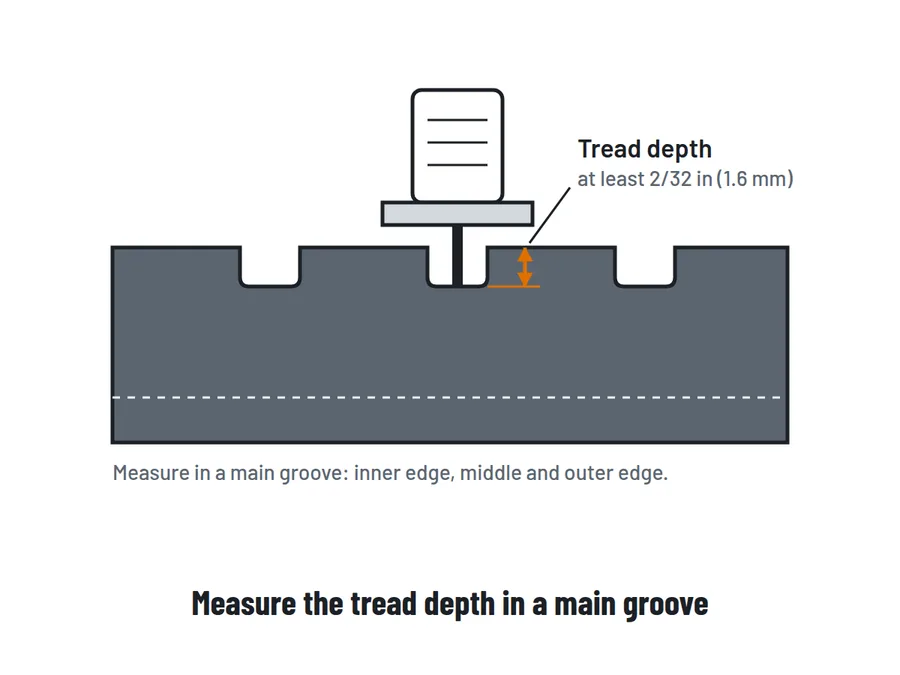
- Measure the tread depth in a main groove at the inner edge, the middle and the outer edge. Replace the tire at 2/32 in (1.6 mm), the legal minimum in most US states, or sooner for better grip in the wet.
- Uneven wear across the tread can point to wrong pressures or alignment: worn edges often mean too little air, a worn middle too much.
- Look over the tread and both sidewalls with the flashlight for cuts, cracks, bulges, and nails or screws. Caution: a bulge in a sidewall means the tire is damaged; don't drive on it until it has been replaced.
- Check each tire's age: the last four digits of the DOT code on the sidewall are the week and year it was made ("2419" is the 24th week of 2019). Many tire makers advise replacing tires after six to ten years, whatever the tread.
© 2026 Fischer Interactive LLC. Written for the Ref Sensor tutorial.